
1. Introduction
Artificial intelligence is transforming the way people work, communicate, learn, and solve complex problems. From generating written content to developing software and analyzing large amounts of information, modern AI technologies are becoming an important part of everyday life. Among the companies contributing to this transformation, Anthropic has established a significant position through its research-driven approach to artificial intelligence and responsible technology development.
Anthropic is an AI research and technology company best known for developing Claude, a family of advanced AI assistants and large language models. The company focuses on building AI systems that are reliable, understandable, and controllable. Its research explores how increasingly capable artificial intelligence can be developed while reducing potential risks.
Unlike companies that focus primarily on introducing AI-powered products, Anthropic places considerable emphasis on understanding how AI systems behave and how their decisions can be guided.
Its technology supports a wide range of activities, including writing, programming, research, document analysis, and business productivity. As generative AI continues to evolve, Anthropic is becoming an important company to understand for anyone interested in the future of artificial intelligence.
2. What Is Anthropic?
Anthropic is an artificial intelligence research company that develops advanced AI models, applications, and tools. It was established in 2021 with the objective of advancing artificial intelligence while giving particular attention to safety, reliability, and responsible development.
The company operates as a Public Benefit Corporation, meaning its organizational structure includes a commitment to creating public benefits alongside business interests. Its stated mission is to develop and maintain advanced AI responsibly for the long-term benefit of humanity.
One of Anthropic’s main products is Claude, an AI assistant designed to understand instructions, generate natural language responses, assist with coding, and perform complex information-related tasks.
The company also provides AI capabilities through its developer platform, allowing businesses and software developers to integrate Claude models into their own applications and workflows.
Anthropic has attracted attention from several groups:
- Technology professionals: Interested in advanced AI capabilities and software development.
- Businesses: Looking for ways to improve productivity and automate repetitive tasks.
- Developers: Using AI models to build applications and intelligent systems.
- Researchers: Studying machine learning, model behavior, and AI safety.
- Students: Exploring AI-assisted learning and research.
Anthropic’s approach combines commercial AI development with research into the opportunities and risks associated with increasingly capable artificial intelligence. Anthropic+1
3. History and Founding of Anthropic
Anthropic was founded in January 2021 by a group of artificial intelligence researchers and technology professionals. The founding team included Dario Amodei, Daniela Amodei, Tom Brown, Jack Clark, Jared Kaplan, Sam McCandlish, and other researchers with experience in advanced machine learning and AI development.
Dario Amodei became the company’s Chief Executive Officer, while Daniela Amodei took the role of President. Several members of the founding team had previously worked at OpenAI, where they gained experience developing large-scale AI systems and researching the challenges associated with advanced machine intelligence.
The company’s early objectives focused on understanding how increasingly powerful AI models could be developed safely. Its researchers wanted to explore methods that could improve model reliability, reduce harmful behavior, and make artificial intelligence easier to understand and control.
In December 2022, Anthropic published important research on Constitutional AI, presenting an approach to training AI assistants using written principles and AI-generated feedback.
Over time, the company expanded its research, developed the Claude product family, and introduced tools for developers and enterprise customers. This growth helped establish Anthropic as an influential participant in the competitive generative AI industry. Anthropic+2
4. What Is Claude AI?
Claude AI is Anthropic’s family of artificial intelligence assistants and language models. It is designed to understand human instructions, process information, generate responses, and assist users with different professional and everyday tasks.
Unlike traditional software that follows fixed commands, Claude uses large language models to interpret natural language and generate contextually relevant responses. Users can communicate with it through ordinary written instructions rather than learning complicated programming languages.
Claude supports several practical activities:
- Writing and editing: Creating articles, emails, reports, summaries, and other written materials.
- Research assistance: Organizing information, explaining concepts, and helping users understand complex subjects.
- Software development: Reviewing code, identifying potential errors, explaining programming concepts, and assisting with development.
- Document analysis: Processing supported documents and extracting useful information.
- Problem-solving: Breaking complicated questions into smaller steps and exploring possible solutions.
- Productivity: Helping professionals organize information and complete routine knowledge-based tasks.
Claude is available through its consumer interface and developer platform. Businesses can also integrate supported Claude models into their applications using APIs.
As of November 2026, Anthropic’s model announcements include the Claude Haiku 5.5, Sonnet 5.5, and Opus 5.5 families. These model categories address different requirements, including high-volume tasks, general professional work, and more demanding reasoning and coding activities. Exact capabilities and availability depend on the model and product.
Claude is therefore more than a conversational chatbot. It is an AI technology platform that can support individuals, developers, and organizations across a variety of workflows. Anthropic+2
5. Key Features and Technologies of Anthropic
Anthropic combines several artificial intelligence technologies to develop its products. Understanding these technologies helps explain how Claude works and why its capabilities are useful.
Large Language Models (LLMs)
Large language models are AI systems trained on extensive collections of data to recognize patterns in language. They can generate text, answer questions, summarize information, and respond to instructions. Claude uses this technology to communicate naturally with users.
Natural Language Processing (NLP)
Natural language processing enables computers to interpret and generate human language. It helps Claude understand questions, identify important information, and produce responses that follow the user’s instructions.
Context Understanding
Context understanding allows an AI model to consider surrounding information rather than treating every sentence as an isolated request. This is particularly valuable when users provide long documents, detailed instructions, or multi-step questions.
AI-Assisted Coding
Claude can help developers understand programming concepts, review code, troubleshoot errors, and create software components. Anthropic also develops tools that support more advanced coding and computer-based workflows.
Multimodal Capabilities
Modern Claude models support more than text-based interaction. Supported models can process images, allowing users to ask questions about visual information, charts, and other image content.
Interpretability Research
Interpretability research investigates how AI models process information and produce particular outputs. Anthropic studies internal model behavior to improve scientific understanding of advanced AI systems.
Together, these technologies contribute to Anthropic’s objective of creating useful AI systems that can handle increasingly complex tasks while remaining more understandable and controllable. Claude Platform Docs+2
6. Anthropic’s Approach to AI Safety
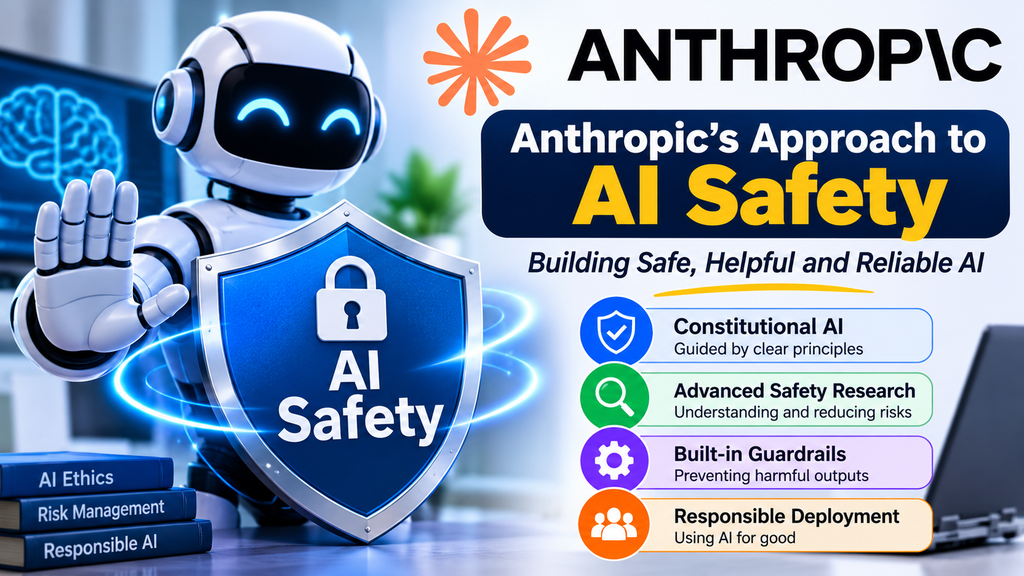
AI safety is one of the central research priorities of Anthropic. As artificial intelligence becomes more capable, it is important to understand not only what these systems can accomplish but also how they might behave in situations involving uncertainty, sensitive information, or potentially harmful instructions.
Anthropic approaches AI safety through research, model testing, training methods, and policies designed to support responsible development.
One of its best-known approaches is Constitutional AI. This method uses a collection of written principles to guide an AI model’s behavior. Instead of depending entirely on humans to evaluate every training response, the system can use AI-generated feedback to assess and improve its answers according to those principles.
For example, a model can be trained to recognize when a response might encourage harmful activity and revise its answer to provide safer information.
Anthropic also emphasizes several important safety practices:
- Model evaluations: Testing AI systems to understand their capabilities and possible weaknesses.
- Red-teaming: Examining how models respond to challenging or potentially harmful instructions.
- Responsible deployment: Considering risks before introducing increasingly capable models.
- Transparency: Publishing research and system information to help others understand model behavior.
- Interpretability: Investigating internal model processes to improve understanding and oversight.
Its Responsible Scaling Policy provides a framework for addressing risks as AI capabilities advance.
However, no AI safety method can guarantee completely accurate or harmless behavior. Continuous testing, human oversight, and independent research remain important for responsible AI development. Anthropic+2
7. Benefits of Anthropic and Claude AI
Anthropic’s technology offers practical benefits for people working in different industries. Its Claude AI models can help users save time, organize information, and approach complex tasks more efficiently.
Students and Researchers: Students can use Claude to understand difficult subjects, summarize educational materials, and explore research questions. Researchers can use it to organize information and assist with document analysis.
Content Creators: Writers, editors, and digital marketers can use Claude to develop article outlines, improve grammar, generate content ideas, and refine existing drafts.
Software Developers: Programmers can request code explanations, identify potential errors, and receive assistance with software development.
Businesses: Organizations can integrate AI into customer support, internal knowledge systems, and document-processing workflows.
Professionals and Teams: Employees can use Claude to prepare reports, summarize meetings, organize projects, and draft professional communications.
The main advantage is that these activities can be supported through natural language instructions. Users do not necessarily need advanced technical knowledge to benefit from AI assistance.
Nevertheless, generated information should be reviewed before it is used in important professional, academic, or business decisions.
8. Anthropic vs. Other AI Companies
The artificial intelligence industry includes several major companies developing advanced language models, AI assistants, and enterprise solutions. Anthropic competes with organizations such as OpenAI, Google DeepMind, and other technology companies working on generative AI.
Although these companies share similar technological goals, their research priorities, products, and approaches can differ.
Anthropic vs. OpenAI: Both companies develop advanced language models and conversational AI products. Anthropic places particular emphasis on AI safety research, Constitutional AI, and model interpretability, while OpenAI develops a broader range of AI products and services.
Anthropic vs. Google DeepMind: Both organizations conduct advanced AI research. Google DeepMind operates within Google’s wider technology ecosystem, while Anthropic focuses on its own research, Claude products, and enterprise AI platform.
Anthropic vs. Other AI Providers: Different AI providers compete through model performance, pricing, accessibility, integration options, and specialized features.
The most appropriate platform depends on the user’s requirements. A developer may prioritize API capabilities, while a business might focus on security, reliability, and integration with existing systems.
Anthropic’s distinguishing characteristic is its emphasis on combining advanced AI development with dedicated safety and alignment research. However, this does not automatically make its models more suitable for every application. Businesses should evaluate available models through practical testing rather than relying on company claims alone. Anthropic+2
9. Business Applications of Anthropic AI
Artificial intelligence is becoming increasingly important for organizations that want to improve operational efficiency and provide better digital services. Anthropic offers AI technology that businesses can use through Claude applications and its developer platform.
One important application is customer support. Businesses can integrate Claude into support systems to help answer frequently asked questions, explain services, and organize customer inquiries. Human employees can remain responsible for sensitive or complicated cases.
Another application is workflow automation. Developers can connect Claude with approved tools and business systems to assist with repetitive tasks, information retrieval, and document processing.
Anthropic AI can also support content development. Marketing teams may use Claude to prepare campaign ideas, draft product descriptions, improve website content, and organize communication strategies.
Software companies can use Claude models for coding assistance, code reviews, and technical documentation. Financial and professional organizations may also explore document analysis and internal knowledge management, subject to appropriate privacy and compliance requirements.
Anthropic’s API allows developers to build customized AI-powered applications instead of relying exclusively on a standard chatbot interface.
For successful implementation, businesses should establish clear usage policies, evaluate model performance, protect confidential information, and maintain human supervision where necessary.
The real business value of Anthropic AI comes from applying its capabilities to specific problems rather than introducing automation without a defined purpose. Anthropic+2
10. Challenges and Future of Anthropic
Despite its development and growing influence, Anthropic faces several challenges that could shape its future. The artificial intelligence industry changes rapidly, and companies must continuously improve their technology to remain competitive.
Increasing Competition: Major technology companies are investing heavily in AI research and development. Maintaining competitive model performance requires continuous innovation.
Computational Costs: Training and operating advanced AI models require substantial computing infrastructure, specialized hardware, energy, and technical resources.
AI Safety Concerns: More capable AI systems can introduce new risks. Companies must continue researching ways to prevent misuse, reduce unreliable outputs, and improve model oversight.
Regulation and Compliance: Governments are developing rules concerning AI transparency, privacy, security, and accountability. Anthropic must adapt its products and operations to relevant legal requirements in different markets.
Model Reliability: Even advanced language models can generate inaccurate information or misunderstand instructions. Improving factual reliability remains an important research challenge.
Looking ahead, Anthropic may continue expanding its research into AI reasoning, interpretability, autonomous systems, software development, and enterprise applications.
Its September 2026 announcements of Claude Mythos and Fable 5.1, alongside the Opus, Sonnet, and Haiku families, illustrate the company’s continuing efforts to develop models for increasingly demanding professional and technical tasks.
The future success of Anthropic will depend not only on building more capable models but also on demonstrating that advanced AI can be deployed responsibly and deliver practical benefits. Anthropic+2
11. Frequently Asked Questions (FAQs)
1. What is Anthropic?
Anthropic is an artificial intelligence research and technology company founded in 2021. It develops advanced AI models, including Claude, with an emphasis on safety, reliability, and responsible development.
2. Who founded Anthropic?
Anthropic was founded by a group of AI researchers and technology professionals, including Dario Amodei, Daniela Amodei, Tom Brown, Jack Clark, Jared Kaplan, and Sam McCandlish.
3. What is Claude AI?
Claude AI is a family of artificial intelligence assistants and language models developed by Anthropic. It supports writing, coding, research, reasoning, and document analysis.
4. Is Anthropic an AI company?
Yes. Anthropic is an AI research and technology company that develops artificial intelligence models, developer tools, and business-focused AI solutions.
5. What makes Anthropic different from other AI companies?
Anthropic is particularly known for its emphasis on AI safety, Constitutional AI, interpretability research, and responsible development alongside advanced AI capabilities.
6. What is Constitutional AI?
Constitutional AI is a training approach that uses written principles and AI-generated feedback to guide model behavior toward more helpful and harmless responses.
7. How can businesses use Anthropic AI?
Businesses can use Claude for customer support, content creation, coding assistance, document analysis, information management, and customized AI applications through its API. Human review remains important for critical decisions. Anthropic+2
12. Conclusion
Anthropic has become an important participant in the artificial intelligence industry through its research-driven approach and development of Claude AI. Its work demonstrates how advanced language models can support writing, programming, research, business operations, and many other professional activities.
What makes Anthropic particularly interesting is its focus on combining technological progress with AI safety, interpretability, and responsible development. Its Constitutional AI research and Responsible Scaling Policy reflect an ongoing effort to address the challenges associated with increasingly capable AI systems.
As generative AI continues to evolve, Anthropic will remain a company worth watching. Its long-term impact will depend on its ability to develop useful, reliable, and responsible artificial intelligence that creates meaningful value for individuals, businesses, and society.
Recommended Internal Linking Opportunities
For better SEO performance, consider linking relevant pages using these anchor texts:
- Artificial Intelligence and Its Applications
- What Is Generative AI?
- AI Safety and Responsible AI Development
- Large Language Models Explained
- Claude AI Features and Capabilities
- AI Tools for Business Productivity